
Italiano

Clockmaker.it home
Clockmaker.it - the home of antique clocks

Nocturnal clock replica no. 53

For details and an account of the construction of this clock, I invite you to visit this page of my forum (in Italian).

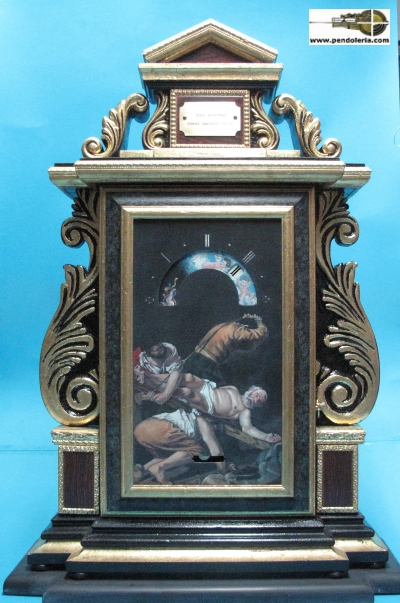
Replica of the nocturnal clock no. 53

Why not a "nocturnal" clock?

This is the question that a couple of friends, Daniele and Guido, and I asked ourselves when we had to decide which type of clock to build for the 10th anniversary of the birth of my forum PENDOLERIA.COM.

Daniele, who is particularly interested in nocturnal clocks, suggested building one of this type... and so our choice fell on a replica of a clock built by the Campani brothers in 1655 for Pope Alexander VII.

Our replica of the nocturnal clock

Since neither I nor my friends had ever seen a nocturnal clock in person, the first thing we felt was necessary was to look for as much documentation as possible.

On the internet, apart from a couple of sites, we could find nothing, so we had to try to understand how things worked by looking at the few available photos and at some information found in books.

In short, Giuseppe Campani had made his clock silent simply by eliminating the escape wheel and its little anchor.

The gear train therefore moved continuously (unlike ordinary clocks, in which it stops between one tick and the next) and ended with a connecting rod and crank system that gave motion to the pendulum, whose continuity of oscillation was also ensured by the presence of a flywheel.

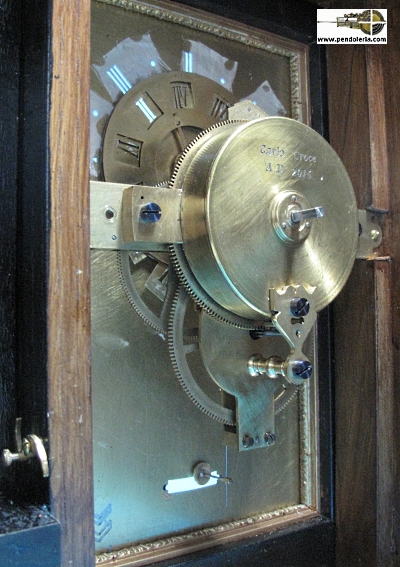
To guarantee an adequate running time for the clock, the barrel was fitted with a very long mainspring: I, who took care of building the movement, had to fit one about 9 metres long.

The great wheel made one turn in two hours. Through a series of gears it drove a ten-sided disc which, in turn, pulled a chain made of 12 cartouches, on each of which one of the 12 usual numerals of an ordinary clock was pierced.

In the course of one hour, one cartouche (visible through a small window in a disc fixed to the ten-sided disc) moved from the far left of the semicircular window, passing under the various "quarters" (I, II and III), thus making it possible to read the hours and minutes.

Once the cartouche reached the right-hand end, and that hour therefore ended, it disappeared and gave way to the reading of the next hour on the new cartouche that appeared on the left.

I hope that, with these few words, I have managed to explain that succession of events which seems very complicated but is in truth very simple in its ingenuity.

The construction of the movement was rather laborious and difficult. There are no conventional plates, in which the holes for the arbor pivots are made by pairing the plates themselves, and above all, with no construction drawings or references available, each component had to be designed by imagining the one with which it would have to interact.

The barrel of the nocturnal clock replica
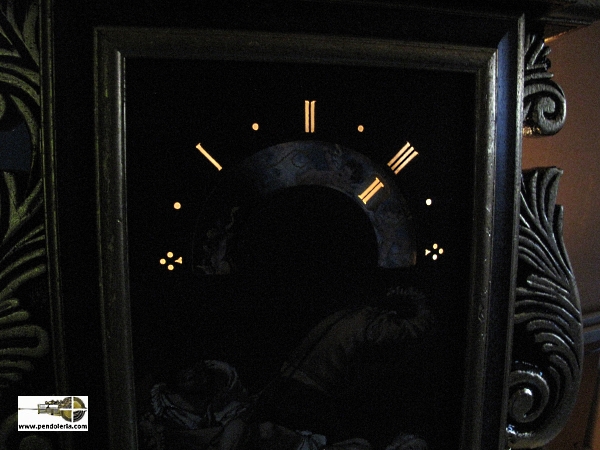
Night view of the hours on the dial of the nocturnal clock replica
the hours as seen at night

Daniele offered to build the case of our clock. So, once I had finished the movement, I sent it to him and he, excellent carpenter that he is, drawing inspiration from existing models, made one that in my opinion is truly beautiful.

To complete the clock, only the "mostra" was missing, that is, the painting that adorns the front of the case. A great admirer of Michelangelo Merisi, better known as "Caravaggio", I could not resist the temptation to ask Guido to try to compose, on the brass sheet that makes up the "dial" of the clock, an enchanting painting full of spirituality and therefore suited to an object that was destined for papal rooms: The Crucifixion of Saint Peter.

I think I can say that the skill with which Guido carried out his task could have drawn a positive comment even from Caravaggio himself…

During the night a small lamp placed inside the case was lit. The light it gave off, passing through the cartouches with the hours and the other pierced parts of the dial, made it possible to read the time even in the dark.

I shaped the outside of the chimney that collects the fumes of the lamp like the smokestack used during the papal conclave to announce, with white or black smoke, whether or not a Pope has been elected.

I am extremely satisfied to think that the 10th anniversary of my forum was the occasion for three enthusiasts, who had never had the chance to meet or even to know each other personally, to pool their experience through the internet to build a clock that I hope may end up in a museum.

For more images of this replica of the nocturnal clock, click here

all my clocks

Reproduction of part or all of the contents of any of the pages of this site is prohibited except to the extent permitted below.
These pages may be downloaded onto a hard disk or printed for your personal use without alterations. This copyright notice and the source must appear on each copy. These pages may not be included in any other work or publication, or be distributed or copied for any commercial purpose except with the explicit permission of the author.